

Two Visions, One Reckoning

Two images from the past week have been rattling around in my head.
The first: Barack Obama standing in front of his presidential library, talking about citizenship, democracy, institutions, character, and our obligations to one another.
The second: Donald Trump sitting ringside for a UFC card on the South Lawn of the White House.
Two visions of the presidency. In some ways, two visions of the country.
One is the presidency we want our kids to believe in.
The other may be the more honest version.
It’s an almost irresistible contrast.
Obama and Michelle Obama embodied something most Americans claim to admire: ordinary people with extraordinary gifts who reached the highest office in the land through talent, discipline, and perseverance. The merit-based American dream the way we narrate it to ourselves.
Trump represents a different American story. A man born on third base who has spent much of his life trying to steal home. Handed advantages most people can only dream about, yet perpetually convinced he’s been cheated out of something more.
One story celebrates achievement. The other celebrates winning. That’s the easy version of this column. And maybe it’s even the correct version. But it’s also the obvious version.
The more interesting question isn’t what Trump tells us about Trump.
It’s what Trump tells us about Obama.
Because the longer Trump remains at the center of American politics, the harder it becomes to separate the Obama presidency from the reaction it produced.
And that means we’re going to spend the rest of this century reassessing Barack Obama through a lens that didn’t exist when he left office.
Presidential legacies never sit still.
Sometimes a single book changes the conversation. David McCullough did it for John Adams Harry Truman. Ron Chernow did it for Ulysses Grant. We’re still waiting for Robert Caro’s final volume to tell us what Vietnam ultimately did to Lyndon Johnson’s place in history.
Every generation reads the past through the concerns of the present.
We’ve seen Eisenhower rise. We’ve seen Reagan rise, fall, and rise again. We’ve watched the Clintons cycle from assets to liabilities and back depending on the political moment.
Obama will be no different.
His presidency will be reinterpreted over and over again by future biographers trying to understand the era that followed him.
And right now, the picture is complicated.
By almost every conventional measure, Obama was a successful president.
He inherited a financial collapse and stabilized the economy. He passed major legislation. He governed with discipline. He left office personally popular.
Like Reagan, he possessed a quality that’s difficult to quantify but easy to recognize. He could make people feel better about America’s place in the world. Even many critics understood what supporters found reassuring about him. It’s a quality Reagan, Clinton and Obama all shared.
But there is one area where the Obama record is difficult to defend.
His stewardship of the Democratic Party.
There really isn’t a measure of Democratic Party strength that improved during Obama’s eight years in office.
Governorships. State legislatures. Congressional seats. Local offices.
The party infrastructure weakened considerably while Obama himself remained popular.
He accomplished something few politicians ever do: he built a durable political brand. The problem is that the durable brand was Barack Obama.
Not the Democratic Party.
His brand got stronger. The party’s brand got weaker.
And that raises a question that becomes harder to avoid with every passing year.
Knowing what we know now, what could Obama have done differently to prevent Trump from being his successor?
Maybe the answer begins with the financial crisis.
The administration stabilized the economy, but it never fully satisfied the public’s demand for accountability. Millions of Americans watched powerful institutions survive while ordinary people absorbed the pain. The sense that nobody truly paid a price for the crisis never completely disappeared.
Maybe the answer is succession.
Obama won because voters wanted to turn the page on not just the two political families that were dominating our politics at the time — the Clintons and the Bushes — but the entire boomer generation. While Obama is technically a boomer, he was born in the 60s and lived a cultural life more familiar to Gen X than the Baby Boomer set.
Yet eight years later, he helped engineer a succession plan built around continuity and baby boomers.
In retrospect, that may have been the central political misread of his presidency.
The voters who elected Obama in 2008 weren’t looking backward. They were looking forward.
By 2016, Democrats were effectively asking voters to keep reading the same chapter.
Obama won as a change agent. Hillary Clinton ran as a continuation.
Those are not the same thing.
And perhaps Obama’s biggest political mistake was forgetting why he won in the first place.
The rise of Bernie Sanders was not inevitable in 2016, but it became inevitable when Obama endorsed Clinton. Don’t forget, many of the voters who rejected Clinton in 2008 were looking for someplace to go in 2016. Obama’s defeat of the Clinton-led establishment in 2008 should have been the warning sign for Clinton 2016. And yet, Obama decided to embrace her bid. And what followed: a remarkable share of the Democratic electorate (largely Obama supporters in 2008) were prepared to rally around someone who wasn’t even formally a Democrat. That wasn’t simply a rejection of Clinton. It was evidence that much of Obama’s coalition was already looking beyond the political generation he was trying to preserve.
At the same time, there is another side to the story.
One of the simplest ways to evaluate a two-term president is to ask whether his political heirs can hold the White House after him.
By that standard, Obama’s record is strangely mixed.
His chosen successor lost (Clinton).
His vice president eventually won (Biden).
The succession plan he engineered failed. (We can also debate whether he should have picked a younger, generational peer as his 2012 running mate, but I’ll save that for another column).
The succession plan he didn’t quite intend succeeded.
That may sound like a distinction without a difference, but it matters because political history rarely moves in straight lines. Eisenhower’s vice president eventually won. Reagan handed off successfully to Bush. Clinton’s chosen successor won the popular vote but not the presidency.
The heir test rarely gives a clean answer.
Obama’s is particularly messy.
And that messiness is exactly why the historical verdict on the Obama presidency remains unsettled.
In fact, I suspect Obama’s reputation may improve simply because of the era that followed him.
We have now spent three consecutive presidential elections throwing out the party that held the White House — something we haven’t done in over a century.
What’s more likely: that the winner of 2028 wins reelection in 2032, or that voters continue doing what they’ve done for much of the last decade?
If we are entering an era of constant political turnover — something more reminiscent of the periods that followed Andrew Jackson or Ulysses Grant than the stability Americans grew accustomed to after World War II — Obama begins to look different.
Not because he changes.
But because the comparison changes.
He became the last president who governed for eight years and walked away still standing.
Which brings me to a thought experiment I’ve become mildly obsessed with lately after a colleague brought it up to me at a recent breakfast.
The unintended consequences of the 22nd Amendment.
The rationale for the amendment was understandable. After Franklin Roosevelt, neither party wanted to normalize presidents serving indefinitely. Americans have always been suspicious of concentrated political power.
But consider the possibility that presidential term limits produced a side effect nobody anticipated.
They may have made presidents worse party leaders — while better stewards of their OWN personal brand.
A second-term president knows he will never face voters again.
His incentives change.
And for the country, that’s probably a good thing. I’d rather have a president worrying about America’s place in the world than his own political movement’s place in the world.
But it comes with a tradeoff.
He begins thinking about his library, his legacy, and his place in history.
He is no longer thinking about building a durable governing coalition in quite the same way.
Obama may be the purest example of this phenomenon.
The parts of the job he seemed to enjoy most were the big questions: the economy, foreign policy, America’s place in the world.
The part he seemed least interested in was being a party boss.
Would the Democratic Party be healthier today if Obama had been eligible for a third term?
More interestingly, would Obama have governed differently during his second term if a third term had even been a possibility?
Would he have spent more time thinking about succession?
About coalition maintenance?
About the future of the party after he left?
I don’t know.
Maybe Trump was bigger than Obama.
Maybe the forces that produced Trump were bigger than both parties.
Maybe he was inevitable.
But if there’s one decision future reinterpretations of Obama’s presidency will never be able to avoid, he decides to throw the full weight of his presidency behind Hillary Clinton in 2016.
The political reasons were understandable.
The Clintons had been extraordinarily helpful to Obama, particularly during his reelection campaign. Loyalty is admirable in politics.
But sometimes loyalty and political judgment point in different directions.
Many of us who covered Obama closely understood exactly why he made the choice he did.
What he underestimated was how much of his own coalition had already moved on from the Clinton era.
And that’s where I keep returning to those two images.
Obama at his library.
Trump is hosting a UFC card on the South Lawn.
The question isn’t which one is real.
They’re both real.
The question is what the distance between them says about the country — and what future historians will conclude that distance meant.
Because presidential history is never fixed. Every generation rewrites it through the events that follow. Obama’s legacy won’t be settled for decades. The only thing I’m confident about is that Trump is now part of it.
Maybe that ultimately elevates Obama. Maybe it diminishes him.
For now, the verdict stays in pencil.

Top 5 places to take visitors in Washington
The one everyone needs: Vietnam Veterans Memorial
The best war memorial in the country. Don’t just look at the wall — find someone doing an etching and ask who they’re looking for. Every visitor becomes a tour guide. Everyone has a name.
The surprise: Korean War Veterans Memorial
Nobody comes to D.C. saying they can’t wait to see it. Then they get there — the soldiers moving through the field, the faces, the sense of motion — and they linger far longer than they planned.
The hidden gem: Albert Einstein Memorial
Oversized, playful, oddly approachable. A reminder that Washington isn’t just about power — it’s also about ideas. One of the best-kept secrets on the National Mall.
The overlooked one: D.C. World War I Memorial
Most people walk right past it. This isn’t a national memorial — it’s Washington’s own tribute to Washingtonians who served. A reminder that before D.C. was the capital, it was a community.
The one that changes you: Arlington National Cemetery
You can spend hours there and feel like you’ve only scratched the surface. The scale of service, the scale of sacrifice, the sheer number of stories contained in one place. It changes your perspective.
Newest Episode of Dynastic is Out Now!
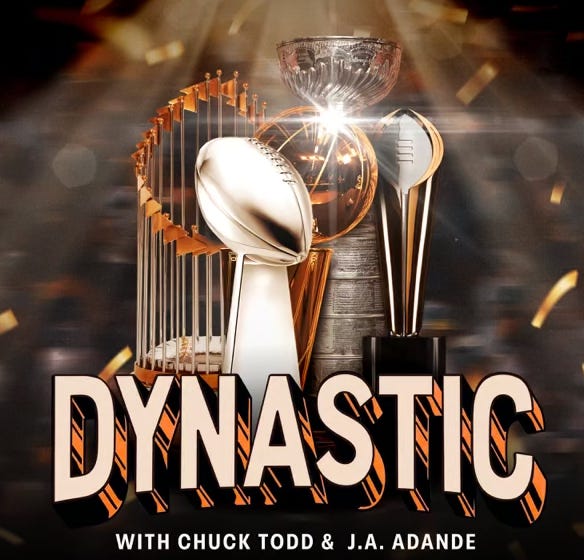
J.A. Adande and I talk with NBA Hall of Famer Chris Mullin to discuss the evolution of the Golden State Warriors from the Run TMC era to the Steph Curry dynasty.
Mullin reflects on his time alongside Tim Hardaway and Mitch Richmond, explains why Run TMC was broken up before reaching its full potential, and shares how the We Believe Warriors helped reignite basketball in the Bay Area. As a former Warriors executive, he also takes us inside the moves that helped lay the foundation for one of the greatest dynasties in sports history.
We also dive into Steph Curry’s impact on basketball, the evolution of the three-point shot, the legendary 1992 Dream Team, the KD Warriors, and whether Golden State’s championship teams will stand the test of time.
The Korean War Memorial is especially awesome at night. Even better with a light rain. My undervisited gem is the FDR Memorial.
Another excellent thought-provoking piece. You'd make a great historian, Chuck.