

THE LONG WAIT
Seven presidents couldn’t resolve their divide. We haven’t confronted ours yet.

I have an obsession. I’ve had it for a while now, and this week’s podcast gave me the chance to air it out. But I want to go deeper here, because the audio version only gets you so far.
The obsession is this: the 24 years between Andrew Jackson and Abraham Lincoln. Eight presidents — though we should be honest that William Henry Harrison and John Tyler barely count as two. Harrison died after 31 days. Tyler, placed on the Whig ticket purely for geographic balance, spent four years getting expelled from his own party. Together they represent one failed experiment, not two distinct presidencies. So call it eight names, seven failures, 24 years, and a country that couldn’t confront the thing that was tearing it apart.
A succession of presidents could feel the country cracking. They just kept reaching for tools that let them avoid naming the argument clearly enough to resolve it. Avoidance. Ticket-balancing. Expansion. Compromise. Legal finality. Every one of those tools bought time. None bought peace.
Martin Van Buren — Jackson’s heir tried to hold the coalition together by simply refusing to engage with slavery as a political question. Avoidance isn’t a strategy. It’s just a slower form of collapse.
William Henry Harrison / John Tyler — Harrison died after 31 days, leaving the country with a Virginia states’-rights man placed on the ticket purely for geographic balance. You can’t paper over a fundamental divide with a clever lineup card. Tyler got expelled from his own party and spent four years proving it.
James K. Polk — Polk’s theory was expansion: get more land, and there’s enough room for everybody. Instead, the Mexican-American War just carried the argument west. New territory didn’t dilute the divide. It gave it more ground to fight over.
Zachary Taylor — A Southern slaveholder who nonetheless told the South to back off its secession threats. He was willing to call their bluff — and he may have been the one president in this stretch with both the standing and the temperament to actually force a reckoning. A Southern man telling the South to stand down carried a different kind of authority. Then he died in office, and we never found out if the bluff was real. Of all the what-ifs in this era, Taylor’s is the one that genuinely haunts. He may have been the off-ramp the country missed.
Millard Fillmore — Signed the Compromise of 1850 — including the Fugitive Slave Act — and genuinely believed he’d settled the question. What he’d actually done was make the North personally complicit in slavery’s enforcement, and hand the abolitionist movement its single greatest recruiting tool. Sometimes the compromise is the crisis.
Franklin Pierce — The Democrats’ theory: nominate a Northern man with Southern sympathies, split the geographic difference, hold the coalition together. Pierce signed the Kansas-Nebraska Act, repealed the Missouri Compromise, and turned Kansas into a preview of the Civil War. The doughface strategy didn’t bridge the divide. It detonated it.
James Buchanan — The most credentialed man to reach the presidency in a generation. He lobbied Supreme Court justices to issue the Dred Scott ruling, then celebrated it as the legal resolution to the slavery question. He was catastrophically wrong and handed Lincoln a country already on fire.
That’s the part of the analogy that still matters. Not the easy cable-news version that says this “feels like the 1850s,” as if historical comparison itself were insight. The real lesson is that a country can spend years managing around a divide because the cost of confronting it still feels higher than the cost of postponing it. Every one of these men saw the divide. They weren’t oblivious — they wrote about it, worried about it, tried to manage it. And each reached for a different tool. Every tool broke.
I keep returning to this period because I think we are living a version of it right now. And the question I find myself unable to stop asking — the one that matters more than any individual poll number or midterm result — is whether we are close to ready to stop postponing.
My honest answer: not yet. Let me explain why. Not with despair, but with the cold-eyed patience that history forces on you if you pay attention long enough.
The Base Trap
Here’s the dynamic driving everything right now, and it doesn’t get discussed with enough precision.
Both parties have looked at the polarized environment we’re living in and seen not a problem to solve but an opportunity to exploit. The logic goes like this: the middle doesn’t like the other guys. There’s a path to a narrow majority without capitulating to the center. And a narrow majority led by the base is still a majority.
The right figured this out first. 2016 proved you could win power without meaningfully compromising with the median voter — if your opponent was unpopular enough and your base was activated enough. That was the laboratory experiment. And it worked, at least electorally.
Now the left wants to run the same experiment. They look at the Biden years and see a cautionary tale — not of overreach, but of insufficient boldness. And they look at Obama — who had massive congressional majorities in 2009 and 2010 and governed more pragmatically than his base wanted — and see a missed opportunity. The unspoken question in progressive circles is: had Obama gone harder, gone for the full wish list from immigration reform to cap-and-trade — used his majority as a mandate rather than a mandate to negotiate — does he transform the country for a generation, even if he doesn’t win a second term?
I’m not here to adjudicate that counterfactual. What I am here to say is that this is exactly the exhaustion-of-maximalism cycle that precedes every genuine political realignment in American history. Both sides have to fully run their version of the experiment before something else can take hold. And we haven’t finished running it.
The right is running its experiment right now — with a record-length government shutdown, an Iran war generating real fractures within the coalition, and approval ratings that have bottomed out at 36 percent in some polls. But the left hasn’t finished its own reckoning. The energy is real — eight million people in the streets this past weekend for the No Kings rallies, younger voters engaging in midterm politics in ways they typically don’t, genuine grassroots mobilization reaching into Shelbyville, Kentucky, and Midland, Texas. But energy and coalition aren’t the same thing. Lower approval for Trump doesn’t automatically produce higher trust in Democrats. The same polls showing Trump at second-term lows still show Republicans holding more trust in the economy, immigration, and crime. That gap hasn’t closed. And until it does, Democrats can win a wave without winning the argument.
The silent question underneath all of this — the one I don’t think anyone has fully answered — is whether there’s a silent majority, or at least a silent plurality, that has simply exhausted itself on this fight. If it’s a majority, the electoral math becomes available to whoever can tap into it. Even a plurality creates real opportunity in a system this closely divided. But I’ve come to believe that you probably need a genuine breakthrough at the state or local level — an independent defeating both parties somewhere significant — before either party feels the structural pressure to change. Until someone loses to a third option, the two-party duopoly has every incentive to keep playing the base mobilization game.
The Core Question We Keep Avoiding
If the 19th century analogy is going to be useful, then we have to answer the question the analogy demands.
In the 19th century, the underlying issue was morally explicit even when politicians tried not to say so: would the country move toward slavery or away from it? Our divide is different, and I want to be careful here. Slavery was singular in its evil. History does not repeat that neatly. But there is a modern version of the same structural problem: we know the country is polarized, yet we still talk around the thing at the center of the argument.
That thing is this: who gets to be an American?
Is America fundamentally a creed — open in principle to anyone willing to embrace it? Or is it something narrower — more inherited, more tribal, more culturally guarded, with a smaller and stricter definition of belonging?
That is the live wire now. Not just immigration policy in the narrow sense. Not just border security, asylum law, student visas, or deportations. Bigger than that. Once you look at politics through this lens, a lot of what seems disconnected starts to hang together. The immigration fights. The rhetoric about “real” Americans. The rise of protectionism and economic nationalism on the right — and some sympathy for it on the left. The argument over whether America should keep trying to shape the world or instead wall itself off from it. Even the debate over globalization looks different through this frame. It isn’t only about wages and trade. It’s about whether we still believe America’s strength comes from openness, confidence, and renewal — or whether we think the safer move is to pull up the drawbridge and preserve a narrower definition of the country.
Ronald Reagan understood this tension and came down clearly on one side. In his farewell address — one of the finest pieces of prose any modern president has delivered — he quoted a letter from a fellow citizen that he believed captured something essential about American exceptionalism:
“You can go to live in France, but you cannot become a Frenchman. You can go to live in Germany or Turkey, or Japan, but you cannot become a German, a Turk, or a Japanese. But anyone, from any corner of the Earth, can come to live in America and become an American.”
Reagan quoted that because he believed it. America was an idea, not an ethnicity. The promise of the country was its radical openness — belonging here was available to anyone willing to commit to it.
That proposition is now being openly contested — not just rhetorically, but at the level of actual governing policy. The MAGA movement, at its animating core, operates from a much stricter and more exclusive definition of who the ideal American is. The policy of fast-tracking white South Africans for refugee status — while simultaneously gutting asylum processes for others — is not a coincidence or an oversight. It reflects a belief system. So does the rhetoric directed at Somali Americans in Minnesota. The question of who belongs, who counts, who gets the benefit of the doubt — that is what is being litigated right now in policy, not just in culture.
And the left’s version of this argument, while different in character, is also an argument about belonging — about who has been systematically excluded, whose claim on America has been denied or diminished.
So we are fighting about the same question the country fought about in the 1840s and 1850s: who gets to be an American, and on what terms. The specifics are different. The moral weight has shifted. But the structure of the argument is remarkably similar — a fight over the definition of membership, with both sides convinced the other’s vision is an existential threat.
The Caricature vs. The Conversation
Here’s what makes resolution so hard: both sides have reduced the other to a caricature, and the caricature is what drives the base.
On immigration — where this argument is most raw right now — the right’s caricature of the left is: no enforcement, no borders, open to anyone. The left’s caricature of the right is: ICE forces deporting anyone who doesn’t look white and European.
Neither is accurate. Most Americans, when polled on specifics rather than vibes, believe things that fit neither caricature. They think we should have borders and that immigration enforcement should exist. They also respond to something like the Reagan quote — to the mythology of America as a place where anyone can become American.
We love that myth, even as we have resented virtually every actual wave of immigrants who arrived to test it. That’s not pure hypocrisy — it’s a very human tension. Every society that has expanded its circle of belonging has done so with reluctance, and then looked back and wondered what the fuss was about. The Irish were going to destroy the republic. Then the Italians. Then the Eastern Europeans. Each wave was a crisis. None of them were. And the country that absorbed them is, by virtually every measure, wealthier and more consequential than it would have been without them.
The economic nationalism driving a significant part of this moment is not purely a right-wing phenomenon — that’s worth saying plainly. There are genuine left-wing versions of protectionism and skepticism about globalization. The desire to put the American worker first cuts across partisan lines. And it’s not without merit; there are real communities that have genuinely lost ground in the globalization bargain, and their grievances deserve to be heard.
But the answer to those legitimate grievances can’t be to redefine American belonging in ethnic terms. And that’s the conflation happening right now — economic nationalism sliding into racial and cultural exclusivity in ways that are, historically, a very dangerous path.
America, on balance, won globalization. More people around the world want to come to school here, do business here, and build things here than anywhere else on Earth. That was unambiguously true until very recently — and it is becoming less true, as enforcement crackdowns and political rhetoric have begun to spook international students, researchers, and entrepreneurs in ways that will take years to fully measure. That’s not just a values argument. It’s a strategic one. A country that stops believing in its own openness tends to get smaller in ways that compound over time.
Who Are the Whigs?
So if we can’t have that honest conversation within the current party system, the question becomes whether the party system itself is the problem.
In the pre-Civil War analogy, we spend a lot of time focused on the presidency. On the men who failed. But the more instructive story might be what was happening in the party system underneath them.
The Whig Party — the primary vehicle of opposition to the Democrats through most of this period — didn’t just lose repeatedly. It collapsed. It collapsed because it kept trying to manage the slavery question with the same toolkit that had stopped working. After all, its coalition was too internally contradictory to take a clear position, and because voter after voter who opposed the Democratic vision of America eventually concluded that the Whigs simply weren’t a credible alternative. They weren’t going to be the ones to force the reckoning.
So something new emerged. The Republican Party — founded in 1854, explicitly anti-slavery-expansion, built from the wreckage of the Whigs and the remnants of smaller third-party movements — won the presidency in its second national election. Six years from founding to Lincoln. That’s how fast a realignment can move once the old vessel finally cracks.
Which brings me to the question I can’t stop sitting with: who are the Whigs in this scenario?
Is it the Democrats — a party that has struggled to articulate a coherent economic identity, that lost working-class voters it once took for granted, that keeps reaching for coalitions that don’t quite hold? Or is it the Republicans — a party whose pre-Trump establishment was functionally replaced, whose remaining institutionalists have largely been absorbed or expelled, and whose current coalition may not survive the post-Trump succession battle intact?
Or is it both? Is the endpoint of this era not one party winning and one losing, but both parties breaking down in ways that create space for something that doesn’t exist yet?
I don’t know the answer. I’m not sure anyone does. But I think it’s the right question — because the lesson of the 1850s isn’t just that the right leader eventually arrived. It’s that the right leader needed a new vehicle to arrive in. The Whigs couldn’t produce Lincoln. They couldn’t even produce a credible alternative to the crisis. It took people giving up on the Whigs entirely, and building something new, before the country had a political instrument capable of confronting the fundamental question.
We may be closer to that moment than the daily noise of shutdown fights and poll numbers suggests. Or we may be a decade away. But that’s the variable worth watching — not which party wins in 2026, but whether either party, as currently constituted, is capable of being the vehicle for a politics that actually resolves something.
The Whigs weren’t. And they’re gone.
So, Where Does This Leave Us?
Each of those presidents tried to paper over just enough of the divide to win power, without resolving enough of it to reduce the polarization. That’s not a critique unique to them — it’s the rational strategy in a system that rewards winning elections over solving problems. And we are running the same play right now, on both sides.
Lincoln’s answer was to name the thing directly. To say: this is what we are fighting about, this is what the country has to decide, and I am going to govern as though the decision matters. He paid an enormous price for that clarity. So did the country.
I am not suggesting we need another civil war — I want to be explicit about that. The stakes of our current divide, while real, are not structurally analogous to the stakes of slavery. But the principle holds: you cannot resolve a fundamental divide by managing it. At some point, you have to name it, frame it honestly, and give the public a real choice. Not a choice between caricatures. A choice between competing visions, argued for in good faith, with the recognition that the other side is not evil — just wrong.
We don’t have that yet. We have two parties, each convinced that one more election, one more mobilization, one more wave gets them to dominance. And as long as both sides believe that, the cycle continues.
I’ll be watching 2026 for early signals — not primarily at the congressional level, though the margins matter enormously, but at the state and local level, where the experiments that eventually go national tend to start. If something breaks through there — an independent win, a cross-partisan coalition, a candidate who refuses the base mobilization playbook and wins anyway — that’s the signal worth tracking. And I’ll be watching both parties for signs of structural strain. Not just electoral losses, but the kind of internal fractures that precede a Whig-style collapse — where voters don’t switch sides, they go looking for a new side entirely.
Until then, we’re somewhere between Pierce and Buchanan in this story. The tools are breaking faster and more visibly. The pressure is building. But the moment of decision hasn’t arrived.
It took a war that killed 700,000 Americans before the country decided the cost of delay was finally higher than the cost of resolution. I’d like to think we can find our way through our version of this without anything like that price. But I’ve been doing this long enough to know: wishful thinking is not a strategy.
It’s just a slower form of collapse.

For more on this topic, check out this past Monday’s episode of the ToddCast below.
Another Note:
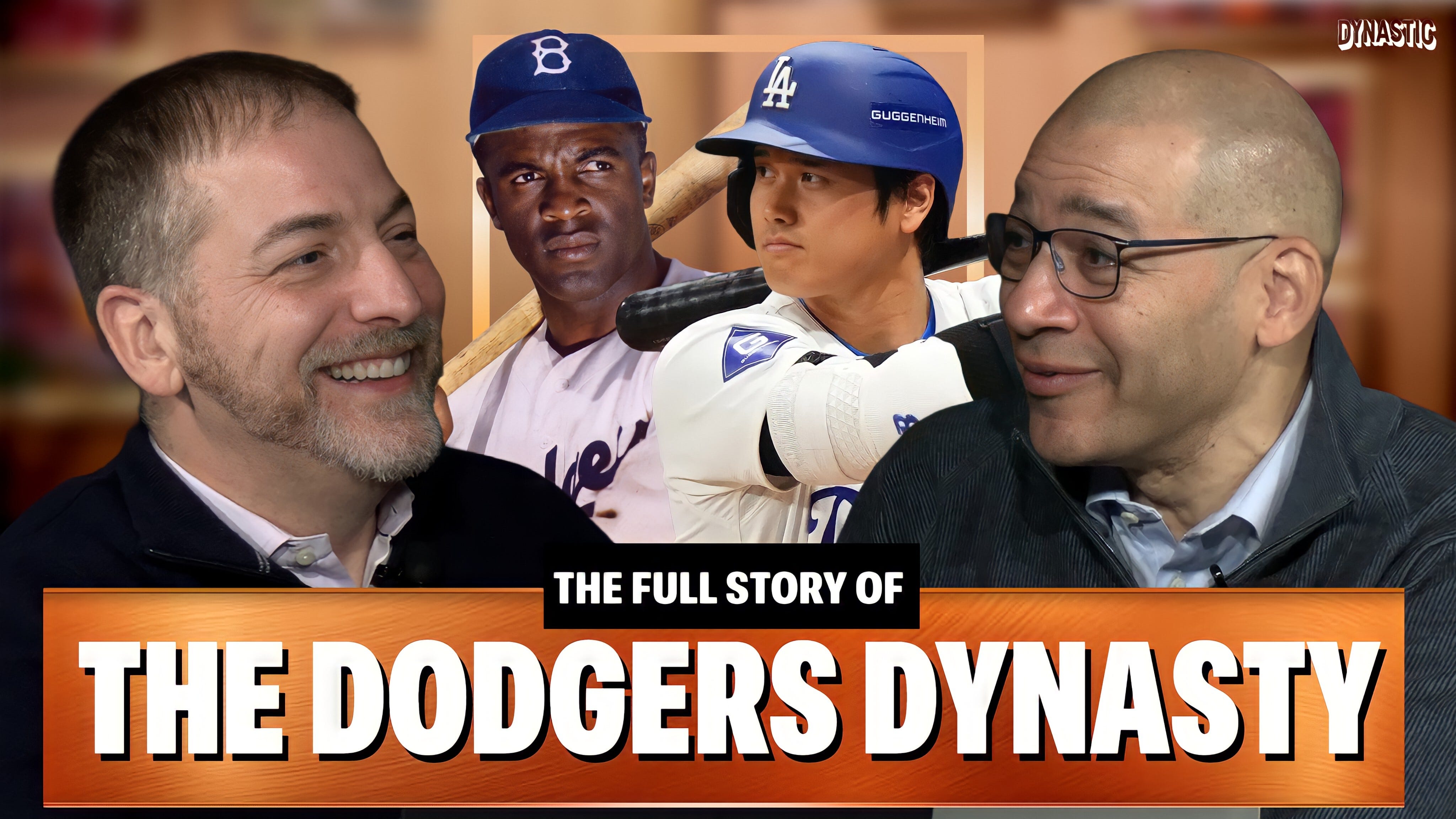
My new podcast Dynastic is here — and we’re already rolling.
Episode 1 is out now, and this week we’re dropping another Dodger-related interview you won’t want to miss. Me and J.A. Adande are taking a deep dive into one iconic franchise every month — the teams you love, the teams you love to hate, and the ones you’ve always been curious about.
This month: the Dodgers. Next month: the Steelers.
Subscribe now wherever you get your podcasts — and listen to the first episode at the link below.
This is Dynastic.

Chuck Todd: You made a lot of good points. But I’m a scientist. I see one party rejecting science, and one party accepting it. One party calling climate change a hoax and saying vaccines kill more people than the diseases they were meant to prevent. For me, the two parties are not equally bad. For me, as a scientist, it is good versus evil. Perhaps you will say “yes, but there are very few scientists, and the rest of the country views things differently.” Maybe. But I, a scientist, see a Republican War on Science, and my goal in life is to oppose the Republicans in that war.
Some compelling arguments here, Chuck. Thanks, as always, for your political and historical insight.
Some additional food for thought -- there are many reasons the Dems are underwater, and much of it has to do with their own base. Their base is (rightfully) angry at them. Angry that they aren't fighting Trump and his autocratic rule enough. Angry that they aren't pushing back in any meaningful way (even if that pushing back is just through sharp rhetoric and feel-good rallies). A few are. The majority are not. Instead, they are sitting idly by waiting for a blue wave and doing little to earn it.
Additionally, many Dems are still holding a grudge about Biden running again and the disastrous DNC for supporting that run. And then anointing Kamala to be his successor instead of giving the people any say in the matter. I also think there are more Dems feeling like the billionaire class has way too much control over both parties now.
Personally, I'd love to see the Dems collapse (a la the Whigs) with a new party rising from the ashes -- one that truly works as the anti-billionaire party. It would have the passion of Bernie Sanders and the pragmatism of the political center. I can see that party capturing people on all parts of the political spectrum.
But alas, that's just my personal pipe dream.