

The 2026 Midterms Begin This Week. Here’s What They’ll Tell Us — and What They Won’t.

The 2026 midterms officially begin this week with the first primaries in Texas.
As a political junkie, I couldn’t ask for a more fitting starting point. This cycle already feels larger than a routine midterm, and it opens with party-defining primaries that go directly to the identity questions facing both Democrats and Republicans.
After months of positioning, recruiting, and fundraising, we finally started getting votes. And once votes are cast, campaigns stop being theoretical. We move from speculation to evidence.
Since election night 2025, the structural baseline hasn’t shifted much. Democrats begin this cycle favored to flip the House and as underdogs — roughly a one-in-three shot — to win the Senate. That’s been the working assumption in both parties.
But what we’re about to learn isn’t just which candidates are strongest. We’re going to start learning what kind of election this actually is — and what kind of parties are heading toward 2028.
Whether anyone says it explicitly or not, this is the first sorting contest of the post-Trump era — even if Trump’s influence over 2026 still looms large.
The Democratic Identity Question: Beyond “Not Trump”?
The central Democratic debate isn’t simply progressive versus moderate. It’s definitional.
For nearly a decade, opposition to Donald Trump has been the party’s most reliable unifying force. That coalition has worked in key elections. But opposition is not a governing identity — and it’s not necessarily durable once Trump himself is no longer on the ballot.
So the question hovering over these primaries is straightforward:
Can the Democratic Party define itself as something more than “not Trump”?
You can see that identity tension plays out most clearly in Texas, in the Democratic Senate primary between Rep. Jasmine Crockett and state Rep. James Talarico.
This hasn’t been a classic “left vs. center” policy fight. It’s a debate over how Democrats should present themselves in the Trump era.
• Crockett is running a confrontational, nationalized campaign — sharper rhetoric, more comfortable prosecuting the case against Trumpism directly, and more willing to energize the base through conflict.
• Talarico is making a different bet: a values-driven, persuasion-oriented campaign that seeks to expand the coalition — including in areas where Democrats have steadily lost ground — and to present not just policy contrast, but tonal contrast.
That’s why Texas matters beyond Texas. It’s an early read on whether Democratic voters want candidates who match the temperature of the moment — or try to lower it. Whether “not Trump” remains sufficient glue, or whether voters are looking for a clearer affirmative brand heading toward 2028.
Michigan’s open Senate race adds another layer.
Here, the differences are more explicitly ideological.
• Haley Stevens occupies a more traditional institutional lane.
• Abdul El-Sayed is running as a clear progressive populist.
• Mallory McMorrow is attempting to bridge factions — rhetorically sharp, culturally fluent, but careful not to alienate moderates.
Michigan is a presidential battleground. The kind of Democrat that wins that primary will tell us something meaningful about the coalition that may define 2028.
Then there’s Maine.
Maine offers a similar stylistic debate to Texas — but in a very different political setting.
In the Democratic primary, Graham Platner has emerged as the sharper-edged, more confrontational voice. His approach is more prosecutorial and more comfortable framing the race as part of a broader national fight.
Contrast that with Democrats aligned more closely with the governing lane shaped by Janet Mills — steady, pragmatic, institutionally minded. Mills’ influence over the party apparatus matters here. Maine Democrats have won statewide by projecting competence and restraint, not by running fully nationalized campaigns.
And looming over everything is Susan Collins, whose long-standing success reinforces a central strategic question for Democrats:
How do you win in a state that values independence and split tickets?
In Maine, the divide isn’t sharply ideological. It’s strategic and tonal. How confrontational is too confrontational? How nationalized is too nationalized?
Across Texas, Michigan, and Maine, the same larger question keeps surfacing: is the Democratic brand economic populism? Institutional competence? Cultural counterpunching? A blend?
The primaries won’t resolve that debate. But they will tell us which lane Democratic voters are gravitating toward.
⸻
Republicans: Is Trump Still the Center of Gravity?
On the Republican side, the question is less about identity and more about gravity.
Donald Trump is in the sixth year of his two-term presidency. He cannot run again. Yet he remains the organizing force in Republican primaries. It’s remarkable that he still holds this level of influence, given how polarizing he remains with the broader electorate.
Candidates continue to seek his endorsement. Many structure their campaigns around demonstrating alignment. In Texas, the early maneuvering in statewide and House races underscores just how central his approval remains.
The real question in 2026 is whether alignment with Trump is uniformly advantageous — or whether it begins to show geographic limits.
In safe Republican districts, running hard toward Trump is rational politics. In competitive suburban districts — Phoenix, parts of Georgia, outer Philadelphia suburbs — the calculus is more delicate. There, candidates are testing how closely to align with Trump without alienating swing voters.
If Trump-aligned candidates win both primaries and competitive general elections, that reinforces his dominance heading into 2028.
If they win primaries but struggle in November, that opens a more serious internal conversation about whether Trumpism expands the coalition — or caps it.
There’s also a substantive test embedded here. On foreign policy — particularly after Trump’s strike on Iran — even traditionally hawkish Republicans have had to recalibrate. If primary voters punish deviation from Trump on issues like trade, NATO, or military posture, that suggests Trumpism has hardened into an ideology. If loyalty to Trump overrides issue consistency, that signals something different.
⸻
The Independent Experiment
Another underappreciated feature of 2026 is the number of credible independent candidacies.
In Nebraska, Dan Osborn is again testing whether an independent can be competitive statewide without formally aligning with Democrats. His strategy depends on maintaining distance from a national Democratic brand that has struggled in the state.
If Osborn runs close, that reinforces the idea that independents can register dissatisfaction but not prevail. If he wins, it forces both parties to reassess their assumptions about red-state politics.
In Michigan, Detroit Mayor Mike Duggan’s independent run for governor is a more consequential test. Michigan is a core presidential swing state. If an independent can win there, it will reverberate nationally and intensify speculation about 2028.
You’re also seeing credible independent efforts in states like Montana, South Dakota, and Kansas — each reflecting Republican dominance paired with Democratic weakness, but not necessarily broad satisfaction with the status quo.
The key distinction of this cycle is simple: do independents win, or do they merely compete?
Winning changes narratives. Coming close does not.
⸻
The Incumbent Warning Sign — With History Attached
One of the cleanest early indicators of electoral trouble isn’t polling. It’s primary defeats.
Here’s a rule of thumb from looking at midterm cycles going back to 1970:
If you see more than five House incumbents lose primaries in a year that isn’t driven by redistricting, it’s a flashing red light for the party in power.
Once you get north of five, you’re usually looking at something deeper than isolated local dynamics or scandal-driven losses.
It suggests the base is restless. And base restlessness almost always translates into a broader “flicking of the switch” in November.
In both 1974 and 1994, the party in the White House saw surprising primary losses for incumbents. Those losses reflected a mood — and that mood carried into the general election dramatically.
Now, 2026 is not a clean test of that metric because redistricting is influencing several primaries. New maps in about half a dozen states have created member-versus-member contests and reshaped districts enough to explain some vulnerability.
So we should expect a somewhat elevated number of incumbent defeats. (Look for a few in Texas Tuesday night, and most of them will be best explained by a new map more than anything else).
The key question is how many losses go beyond what redistricting explains.
Are incumbents losing because maps forced them into tougher terrain?
Or are incumbents in otherwise stable districts losing without scandal or structural disadvantage?
When incumbents begin falling in safe districts absent controversy, that’s usually a sign of something larger. It means voters aren’t just frustrated with the other party — they’re dissatisfied with their own.
And in a sixth-year midterm, that dynamic rarely stays confined to the primaries.
⸻
What 2026 Will — and Won’t — Tell Us
We won’t know in November 2026 who the 2028 nominees will be.
We won’t know definitively whether Trumpism can thrive without Trump on the ballot.
We won’t know whether a serious independent presidential run is viable.
But we will know more about the direction.
We’ll know whether Democratic primary voters reward confrontation or persuasion.
We’ll know whether Republican candidates tightly aligned with Trump can win competitive districts.
We’ll know whether independent candidates can break through in meaningful states.
And we’ll have a clearer sense of the electorate’s mood — frustrated but incremental, or frustrated and ready to disrupt.
Midterms often function as course corrections and foreshadowing events rolled into one.
Occasionally, they function as inflection points.
The first primaries this week won’t settle that question.
But they’ll start narrowing the possibilities.
(After researching incumbents losing in primaries in midterm years, I used Claude to put together this chart, which shows a messy correlation.: Do Primary Defeats Forecast Election Waves?)

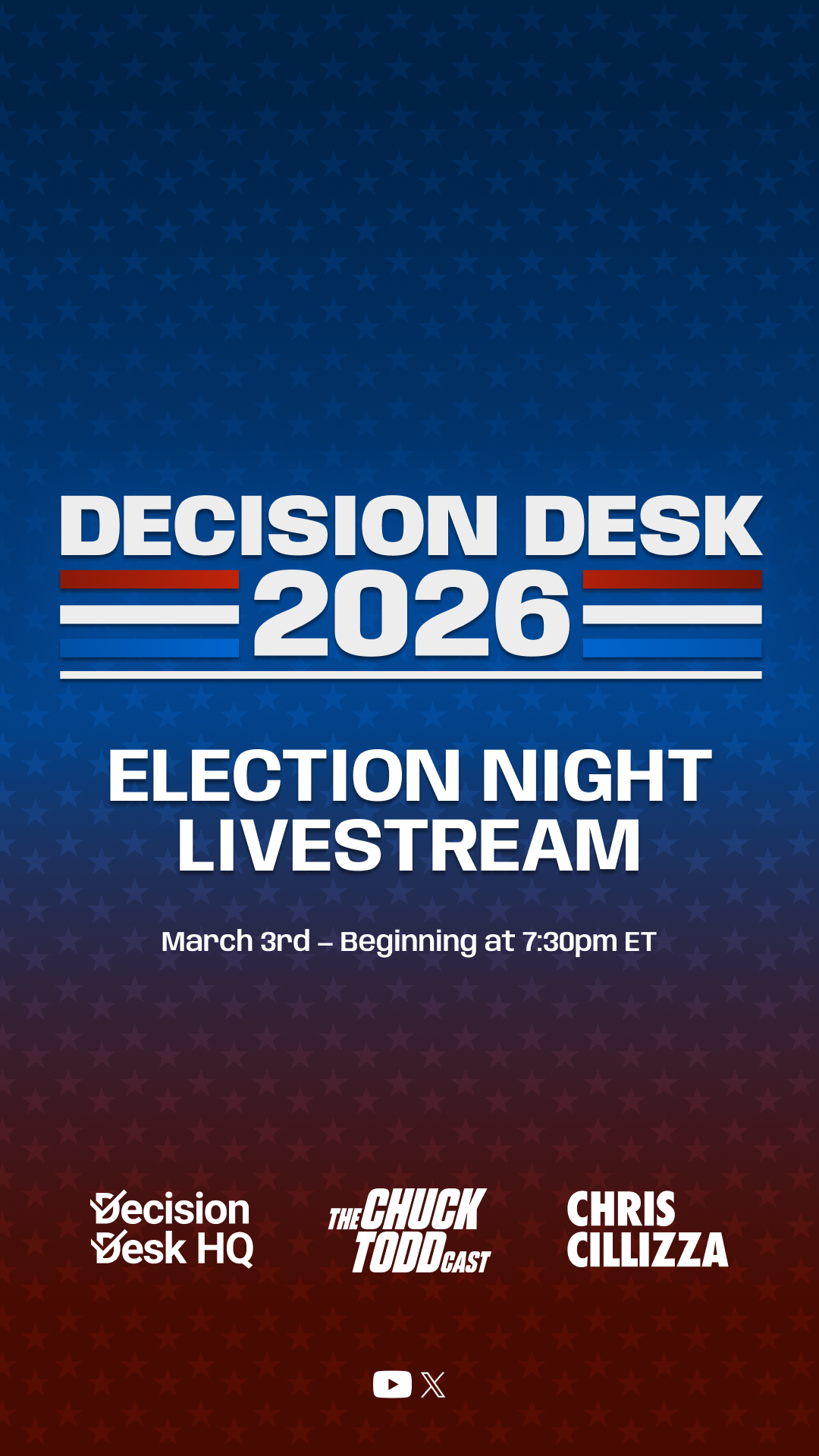
Tonight’s the Night! Join me, Chris Cillizza, and Decision Desk HQ for a special Primary Night Live Stream as we break down the key races in North Carolina and Texas — what the results mean, what to watch for, and how it sets the tone for 2026.
🕢 We go live at 7:30pm ET across all three YouTube channels:
Come watch the numbers roll in and hear smart, unfiltered insights in real time. See you tonight!
I'm in Texas. I'm looking forward to following Chuck and Chris tonight for the election returns.
This is why I pay Chuck Todd.