

From Insult To Identity

One way to understand American politics over the last 20 years is to listen to the insults.
The platforms tell you what the parties want credit for. The speeches tell you what they want voters to hear. The insults tell you something more useful: which parts of the other coalition they are trying to drag into the center of the frame — either to scare voters away from the mainstream of the other party, or to isolate a faction before it gets too big to ignore.
That distinction matters because if you did not live through the campaigns of 2004, 2008 or 2012, a lot of the rhetoric from those years will not sound strange now. Republicans calling Democrats socialists. Democrats warning that Republicans had become radical, racialized, grievance-driven and hostile to immigrants. Put those lines into 2026, and they sound like normal political weather.
And yet, in those campaigns, they were not.
At the time, many of these attacks sounded overheated. Some were unfair. Some were plainly false. Barack Obama was not a socialist. Mitt Romney was not a mob leader. Paul Ryan was not a right-wing revolutionary. John Kerry was not trying to let Paris decide when America could defend itself.
But two decades later, the old attack lines read differently. They no longer sound merely like smears. They sound like rough drafts of the future of both parties.
The parties did not become exactly what their opponents said they were. That would be too neat. But the most animated factions inside each party did something more interesting. They stopped denying the caricature and started embracing parts of it.
The response became a sort of collective confession: Fine. If that is what you think we are, maybe we are. Maybe we should be.
That is how an insult becomes an identity.
In 2004, the old party insults still sounded like old party insults. George W. Bush did not call John Kerry a socialist. He called him a liberal. In the third presidential debate, Bush told Kerry, “There’s a mainstream in American politics. You sit right on the far left bank,” then joked that Ted Kennedy was the conservative senator from Massachusetts.
That was the ceiling of the Republican attack: liberal, soft, out of the mainstream, too deferential to allies, insufficiently enthusiastic about war. It was a 20th-century “Democrats are weak” attack line, and by the early 21st century it was already losing some of its punch.
Culturally, 2004, it turns out, was the last 20th-century election.
The Republican convention that year gave us the purest version of that worldview. Zell Miller accused Democratic leaders of seeing America as “an occupier, not a liberator.” He mocked Kerry as a would-be commander in chief whose military would be armed with “spitballs.” Then Miller delivered the line that defined the era’s Republican foreign-policy swagger: Kerry, he said, would let Paris decide when America needed defending. “I want Bush to decide.”
It was a great attack line. It was also a misleading description of Kerry’s actual position. Kerry had explicitly said he would not give any foreign country or institution a veto over American security.
But that almost makes the line more useful as an artifact. In 2004, the Republican caricature of Democrats was that they were too internationalist, too cautious, too suspicious of American power, too eager to pass what Bush called a “global test” before using force.
Today, the irony is hard to miss. The Republican Party that once treated skepticism of American military projects as weakness now contains the country’s loudest anti-“forever war” faction. The party that mocked Kerry for supposedly caring too much about allied opinion now regularly runs against “globalists” in both parties. Democrats, meanwhile, are often the party most eager to defend NATO, alliances and the old international order.
The parties traded places on the old attack line.
Then came 2008, when the caricatures sharpened.
That year, John McCain became the hinge figure in this story. He held several guardrails at once. He defended free trade against an increasingly skeptical electorate. He defended Obama’s basic legitimacy. He rejected the uglier impulses in his own crowds. And yet his campaign also helped mainstream the charge that Obama represented something close to socialism.
In an October 2008 radio address, McCain seized on Obama’s comment to Joe the Plumber about wanting to “spread the wealth around.” McCain said Obama believed in “redistributing wealth,” and added that Joe had said this sounded “a lot like socialism.” Then McCain made the point explicit: “A lot of Americans are thinking along those same lines.”
McCain also compared Obama’s voting record to Bernie Sanders, then the Senate’s lone self-described socialist. Asked whether Obama himself was a socialist, McCain said, “I don’t know.” But the comparison did its work. Sanders was considered a true ideological outlier then — the outer boundary of imaginable leftism. Eight years later, Sanders nearly won the Democratic nomination.
That is the first part of the turn. The accusation was false about Obama as president. He governed as a pragmatic, mostly free-market liberal, not as a socialist. Actual socialists were not confused about this. But the Republican attack identified a real appetite inside the Democratic coalition: more redistribution, more class politics, more hostility to the market-friendly consensus of the Clinton and Obama eras.
By 2016, that appetite had a candidate. By 2026, the democratic socialist wing was no longer just a campus stereotype or a cable-news punchline. It had become an organized force in Democratic primaries, particularly in New York City, part of a longer insurgent movement that grew out of Sanders’ 2016 campaign.
The second part of the turn is even cleaner: trade.
In 2008, the Republican Party treated free trade as part of its identity. McCain attacked Obama for threatening to renegotiate NAFTA, warning that “you don’t tell countries you’re going to unilaterally renegotiate agreements with them.” He described himself as a free trader and warned against protectionism.
Obama, tellingly, backed away from some of his own campaign rhetoric. The Democrat flirted with anti-NAFTA politics and retreated. The Republican denounced that flirtation as dangerous. Then the next Republican president made renegotiating NAFTA, imposing tariffs, and rejecting the old free-trade consensus central to his politics. And what happened? That candidate peeled away a significant part of the old Democratic labor coalition, particularly in the industrial Midwest and left the Democrats scrambling.
And the story did not stop there. Just last month, Trump put the new Republican posture in a single sentence: “I don’t know that I’m going to renew it,” he said of USMCA. “We don’t need anything that Canada has. We don’t need anything that Mexico has, but they need everything that we have.”
McCain’s hypothetical did not become literal in every procedural sense. USMCA was negotiated and ratified, and even now the agreement remains in effect during the review process. But the posture he described as reckless — threaten withdrawal, force renegotiation, treat trade agreements as nationalist leverage — became Republican orthodoxy.
On the Democratic side in 2008, the charge against the GOP was also sharpening. The argument was no longer just that Republicans were wrong on policy. It was that the McCain-Palin campaign was playing with fear, identity and grievance.
Sarah Palin accused Obama of “palling around with terrorists.” John Lewis warned that McCain and Palin were “sowing the seeds of hatred and division,” invoked George Wallace, and said they were “playing with fire.”
But here is the key fact about 2008: that accusation was still treated as radioactive.
McCain called the comparison beyond the pale. Obama’s own campaign distanced itself from the Wallace analogy, saying Obama did not believe McCain or his policy criticism was comparable to George Wallace or segregationist politics, even while agreeing that some hateful rhetoric deserved condemnation.
That was the old world: even the accuser’s party rushed to police the accusation.
And McCain, again, was the hinge. At a town hall in Minnesota, a woman told him she could not trust Obama because “he’s an Arab.” McCain took the microphone back. “No, ma’am,” he said. “He’s a decent family man, a citizen that I just happen to have disagreements with.”
That sentence now sounds almost antique. Not because there are no decent Republicans left, or because McCain was some flawless saint of civic virtue. But because he was performing a function party leaders were still expected to perform: telling the base no. Or at least telling it to cool it.
By 2012, those guardrails were already weakening.
Rick Perry was asked in a Republican primary debate whether he agreed with McCain’s insistence that Obama was a patriot. Perry’s answer was to declare, proudly, that “we have a president that’s a socialist.”
The claim was not true. But by then, truth was not really the point. The point was permission via “telling it like it is.”
That exchange connects the eras. 2008: McCain tells the base no. 2012: Perry runs against the premise of McCain’s restraint.
Romney, the eventual nominee, still mostly resisted saying the word. His version was more disciplined: Obama believed in a “government-centered nation,” in redistribution, in a larger state. Romney was, in this sense, the last nominee of the old party style. He would gesture toward the caricature without fully becoming it.
Obama’s 2012 attack on Republicans followed the same pattern from the other direction. His harshest argument was not simply that Romney was conservative. It was that the Republican Party had adopted a radical governing blueprint.
At an Associated Press luncheon in April 2012, Obama described the Ryan budget as a “Trojan horse,” “an attempt to impose a radical vision on our country,” and “thinly veiled social Darwinism.” He said the plan was so far right it made the Contract with America look like the New Deal.
Again, the honest caveat matters. Romney and Ryan were institutionalists. The press was not crazy to treat “radical” as campaign rhetoric. In temperament, they were closer to green-eyeshade conservatives than revolutionaries.
But the Democratic caricature was not only about budgets. It was also about immigration.
At the second 2012 debate, Obama attacked Romney’s “self-deportation” position, defining it as “making life so miserable on folks that they’ll leave.” Romney pushed back. He said self-deportation meant letting people make their own choice. Then he drew the line: “We’re not going to round up 12 million people” and take them out of the country. “I’m not in favor of rounding up people and taking them out of this country.”
That may be the most revealing sentence in the whole column.
In 2012, the Republican nominee’s defense against the nativist charge was that, of course, he was not talking about mass roundups. That was the line he would not cross.
By 2024, the Republican platform promised to “carry out the largest deportation operation in American history.” By 2026, the Trump administration was expanding fast-track deportation authority to reach noncitizens arrested anywhere in the United States who could not prove two years of continuous presence.
The boundary moved.
So what happened? How did the caricatures of 15 years ago become simply descriptions of the two parties today?
One answer is negative partisanship. If you call people socialists or nativists long enough, some of them will eventually ask why they are bothering to deny it. The insult loses its sting. The smear becomes inoculation.
Another answer is that caricatures can become a crude form of market research. Attack ads are designed to scare persuadable voters, but they also reveal what each side thinks is gaining traction inside the other coalition. The GOP saw the redistributionist appetite in the Democratic base before Democratic elites were willing to acknowledge it. Democrats saw the restrictionist and nationalist appetite in the Republican base before Republican elites were willing to surrender to it.
That is why the old attacks now read less like prophecy than reconnaissance.
And once politics becomes a stage for rebellion, the old labels change meaning.
“Extremist” is a word people run from. “Rebel” is a word people run toward.
That matters more than we admit. A faction that looks extreme can struggle for legitimacy. A faction that looks rebellious can become attractive. We fear extremists. We root for rebels. So the trick, in modern politics, is to make extremism feel like rebellion against an established power structure.
On the right, nationalism could be sold not as extremism but as rebellion against globalists, elites, bureaucrats and a failed bipartisan consensus. On the left, socialism could be sold not as state control but as rebellion against billionaires, inequality and a failed neoliberal consensus.
The ideas did not have to be new. They just had to feel defiant.
The old establishments had their failures. They suppressed real arguments. They told voters to choose between prepackaged coalitions that did not really represent them. They treated factional energy as something to be managed, not understood.
But they also performed one useful function: they said no.
McCain said no at Lakeville. Obama said no, or at least not quite, to the Wallace analogy. Romney said no to roundups. Obama backed away from his own NAFTA heat. Even the politicians playing with the caricatures still recognized boundaries.
Those boundaries did not hold.
That is the story of the last 20 years. The attack ads of 2004 through 2012 turned out to be the most accurate polling of the era. Each party saw what was gaining traction inside the other coalition before the other side’s leaders were ready to admit it.
There is an institutional explanation for this, too, though it is less emotionally satisfying. The two parties are too big. They are not really parties anymore. They are containers — bloated holding companies for factions that, in a healthier system, would not all be forced to share the same brand name.
Big tents feel good when you are winning. They become dysfunctional when you are not. A big tent lets everyone claim membership, but it also lets a highly motivated faction capture the microphone and insist it speaks for the whole wedding.
The country is more politically diverse than the two-party system allows it to be. There are market liberals, social democrats, national conservatives, libertarians, old-school internationalists, religious conservatives, secular moderates, populists of left and right, and millions of voters who do not fit cleanly into any cable-news category. But the system tells them they must squeeze into one of two parties and hope their faction is running the place.
Then we act surprised when the factions fight because their political lives depend on it. They do.
The United States does not need two parties that pretend to contain every view in American life. It needs a system that lets political diversity show itself more honestly. That could mean more parties. It could mean electoral reforms that make coalition-building happen after voters speak, not before. It could mean expanding the House of Representatives, which has been fixed at 435 seats for nearly 100 years, even as the country has grown far larger and more diverse.
None of that would magically cure polarization. No reform turns human beings into angels. But it might make our factions more visible, more accountable, and less able to hijack half the political system by dominating one primary electorate. In short: it would change incentives, which is usually where better outcomes begin.
The caricature did not become the party because the caricature was always fair. It became the party because the old system left too many factions with only two choices: hide inside a coalition that embarrassed them, or seize the coalition and make everyone else live with the embarrassment.
Eventually, they chose seizure.
The insult became the identity. The caricature became the faction. And then the faction became too big for the party to deny.

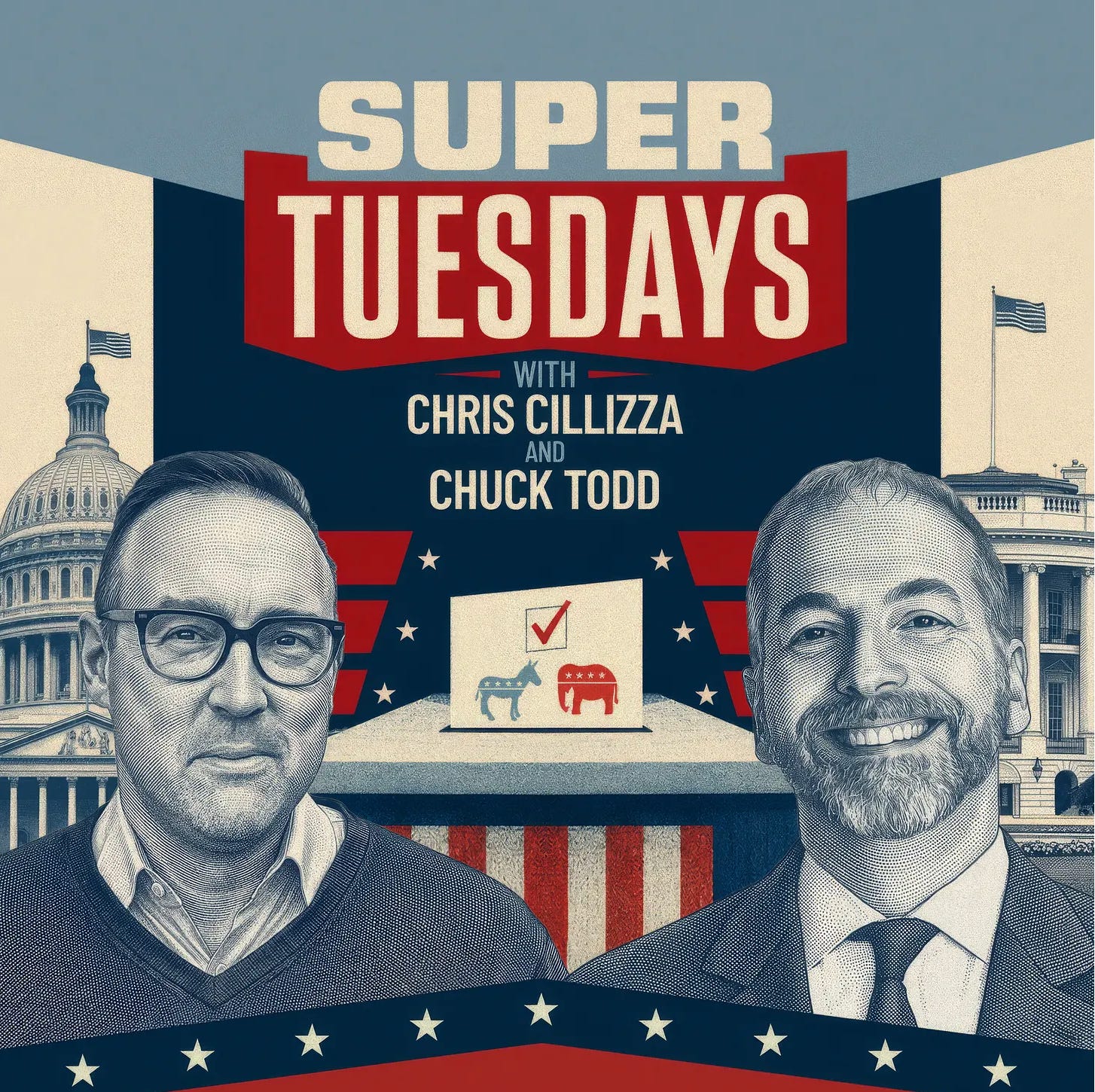
Introducing Super Tuesdays
What started as a weekly conversation between two longtime friends is now officially Super Tuesdays, a new weekly podcast from iHeart.
Every Tuesday morning, Chris Cillizza and I break down the biggest stories in politics, media, sports, and whatever else is on our minds. Same candid conversations, same occasional interruptions—now free wherever you get your podcasts.
The first episode is out now. Give it a listen and join us every Tuesday.
New Episode of Dynastic is LIVE!
J.A. Adande and I tell you the INCREDIBLE story behind Wimbledon. It didn’t just become the most prestigious tournament in tennis—it helped create the sport we know today. From a croquet club raising money for a broken lawn roller to becoming one of the most iconic sporting events in the world, Wimbledon has shaped the rules, traditions, legends, and culture of modern tennis for nearly 150 years.
We trace the full history of the tournament, from its Victorian origins to unforgettable champions like Roger Federer, Serena Williams, Björn Borg, Martina Navratilova, Pete Sampras, Billie Jean King, Althea Gibson, Novak Djokovic, Rafael Nadal, Venus Williams, and more. Along the way, we explore how Wimbledon changed tennis forever—and why the sport wouldn’t be the same without it.
Whether you’re a lifelong tennis fan or just discovering the magic of Wimbledon, this is the story behind the world’s most famous tennis tournament.
Episode is linked HERE.
Are you my mother pretending to be Jon? Seriously, thank you for the kind words. I’ve been stewing on this column for a while. 2012 in particular. The rhetoric between Obama and Romney camps was rough. Not nasty per se but certainly rough. And yet it feels quaint now . The 2012 election was the one that now feels the most outlier ish?
Chuck, this was one of the more interesting pieces I’ve read from you because it wasn’t really about campaign rhetoric—it was about political evolution. Your central thesis, that yesterday’s insults often become tomorrow’s accepted identities, is a compelling lens through which to view the last two decades.
What struck me most was your use of McCain as the hinge between two eras. The contrast between his rejection of the “Obama is an Arab” comment and the politics that followed illustrates how party leaders once saw policing their own coalition as part of the job. I also thought your comparison of trade, foreign policy, and immigration showed that this phenomenon isn’t confined to one party. In several cases, today’s orthodoxies would have been politically unrecognizable to the same parties in 2008.
The section on America’s two-party system becoming “containers” for increasingly incompatible factions was particularly thought-provoking. Whether or not one agrees with your proposed reforms, that diagnosis helps explain why internal party battles have become so consequential. It was a nuanced, historically grounded piece that encourages readers to think beyond today’s headlines.